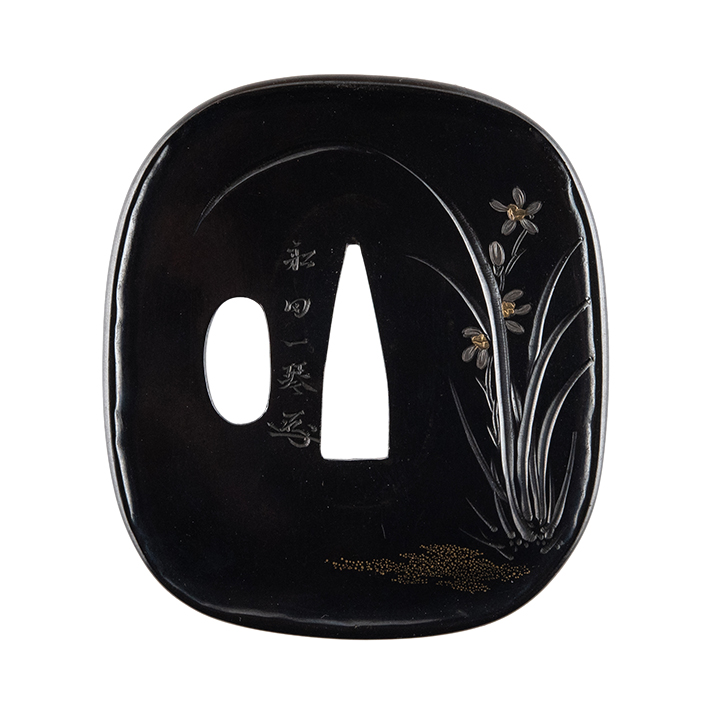
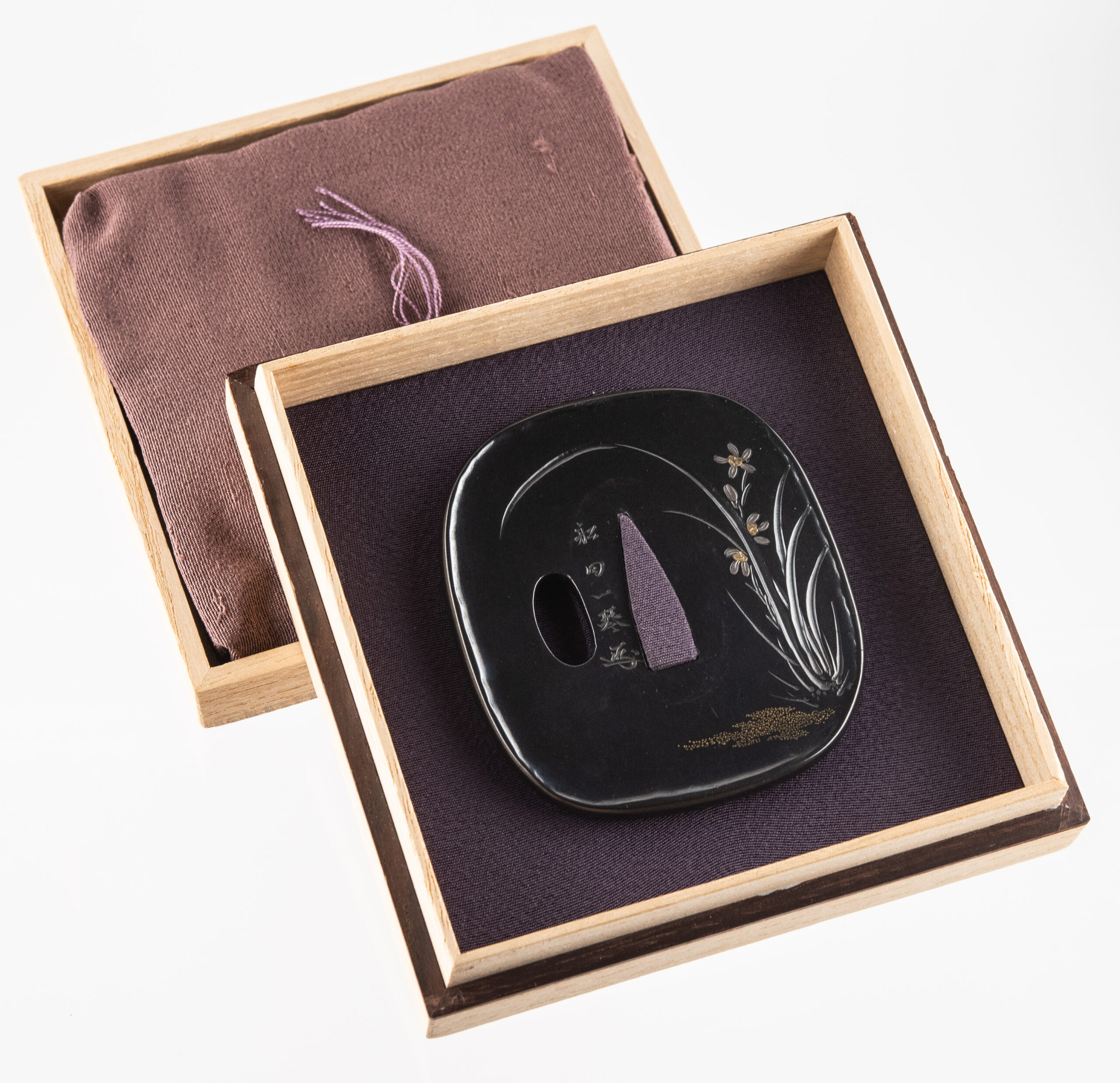
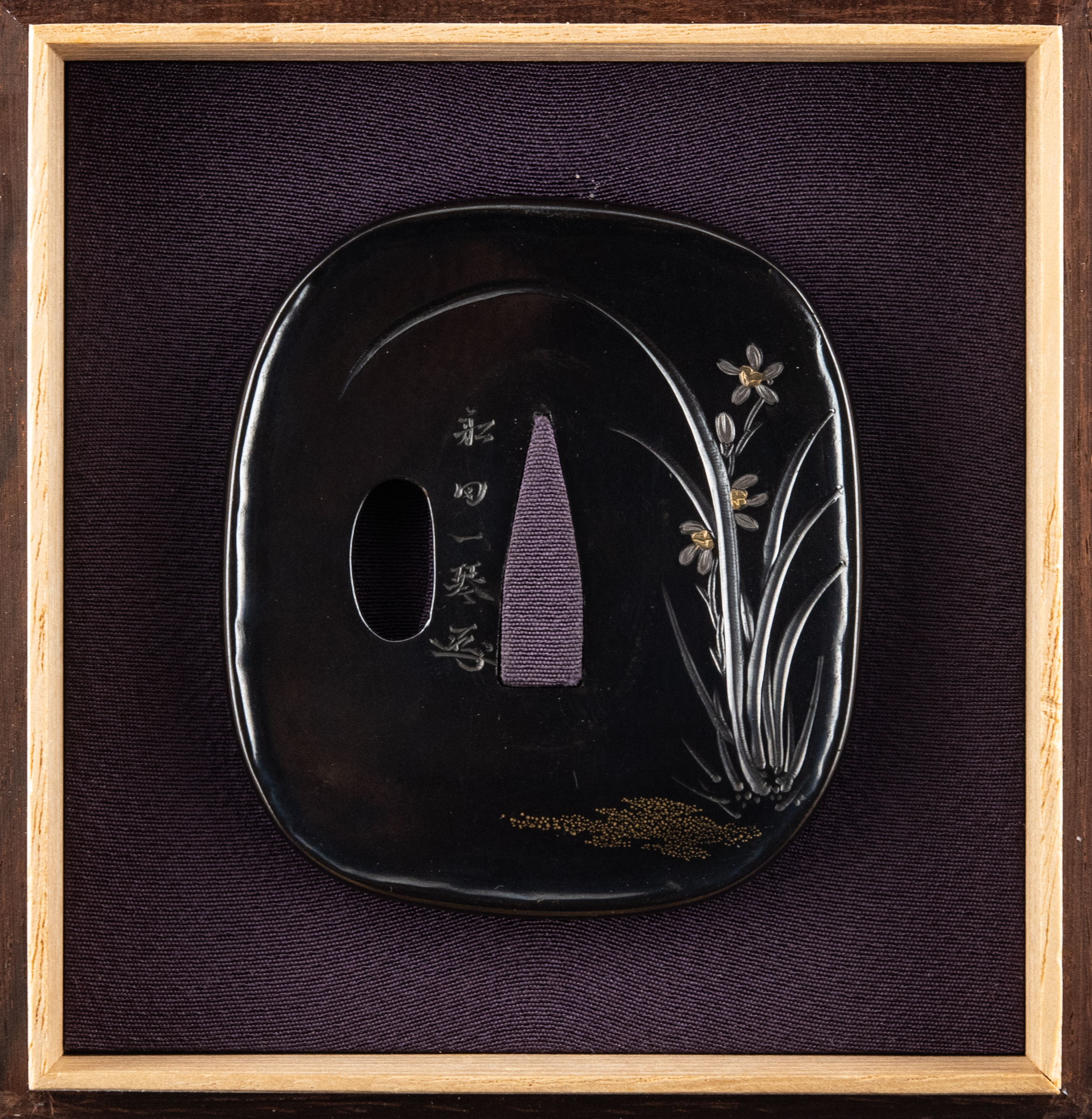
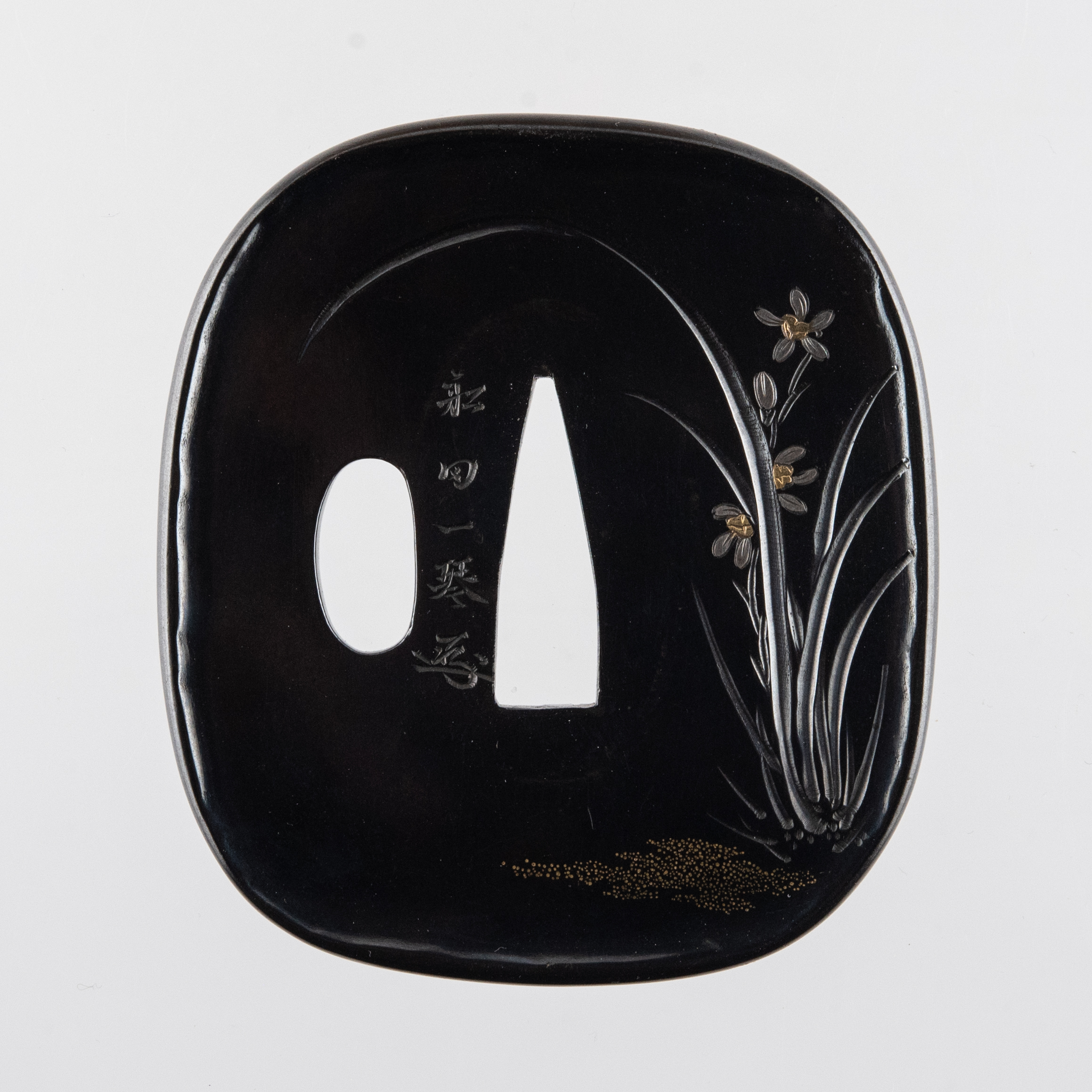
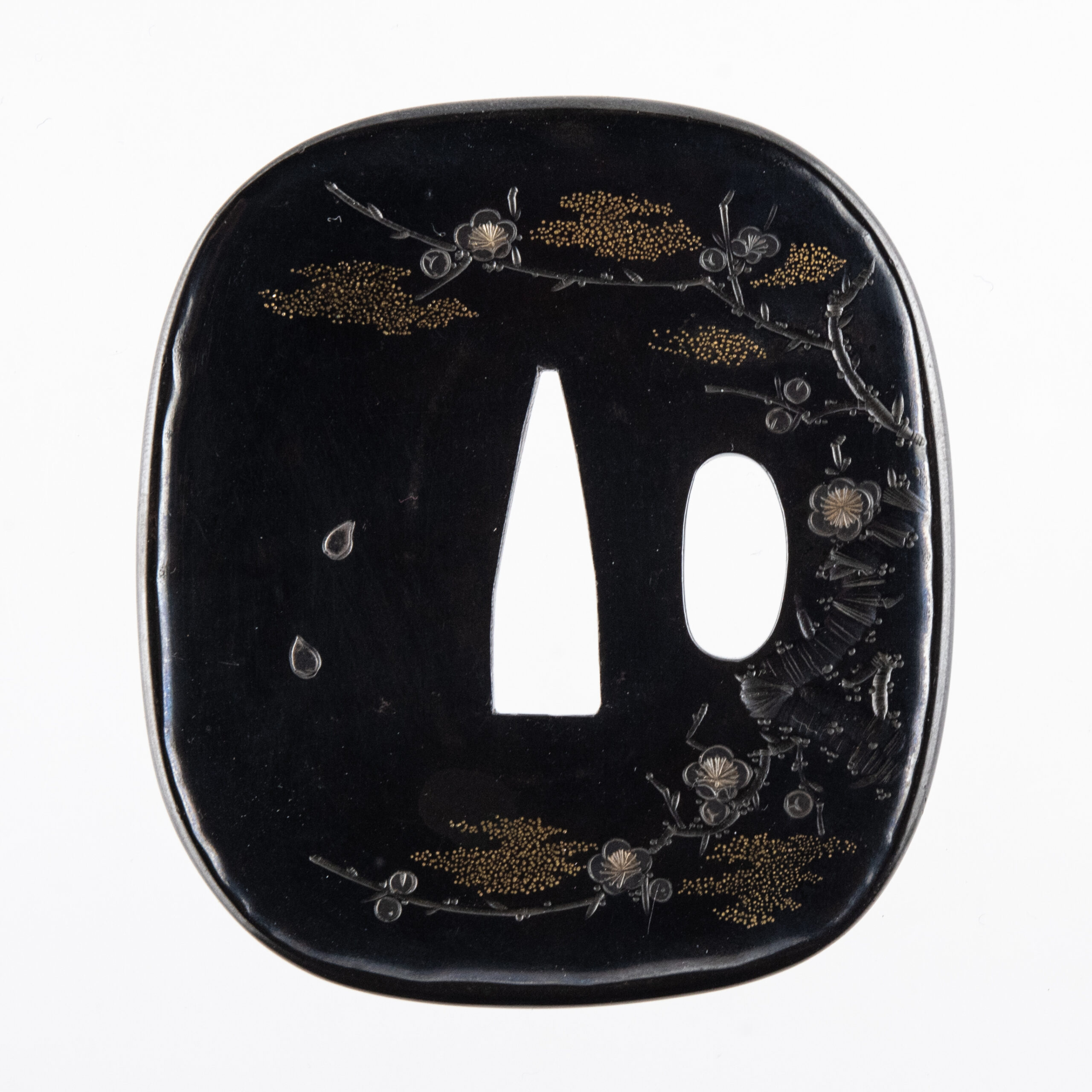
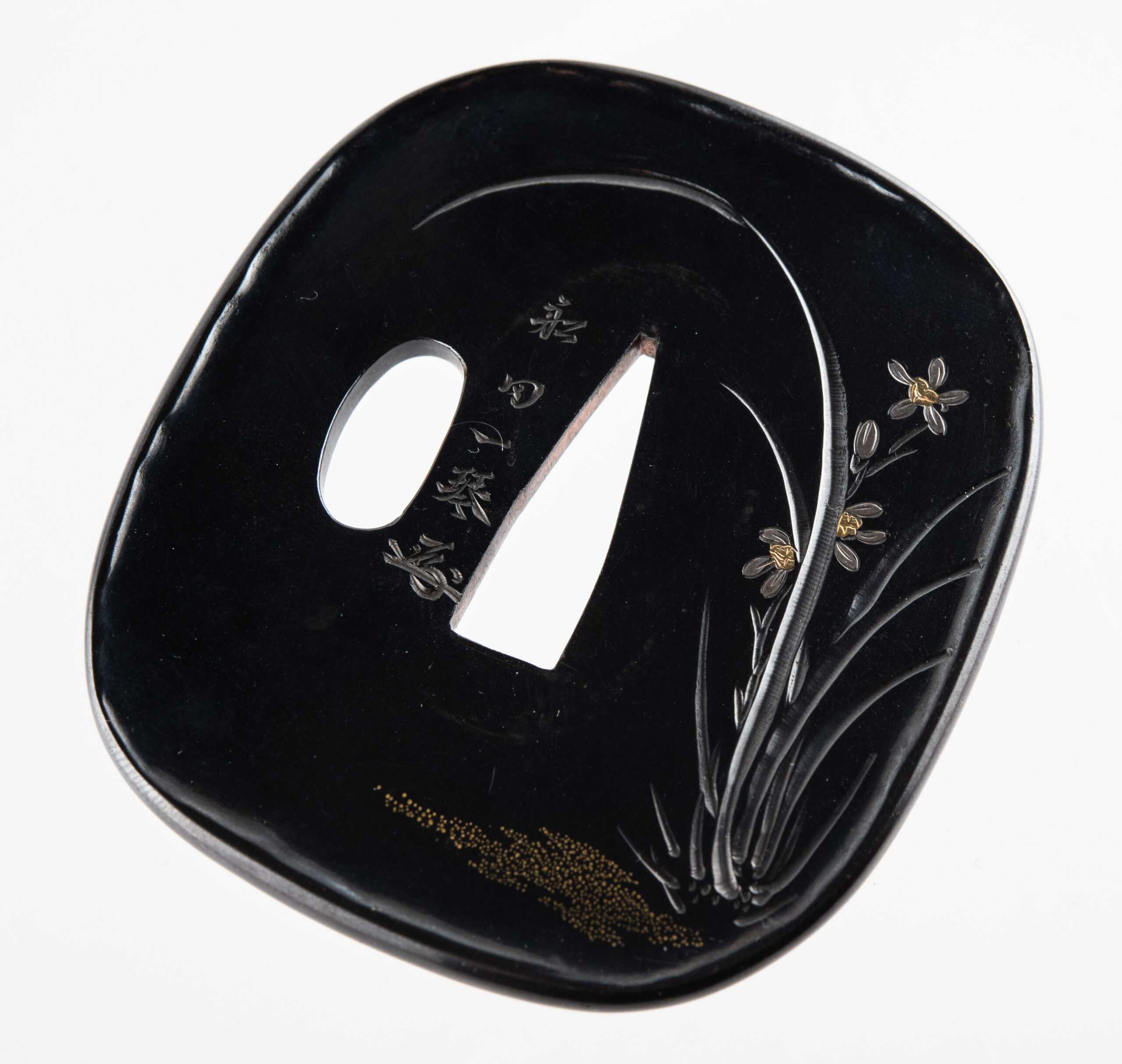
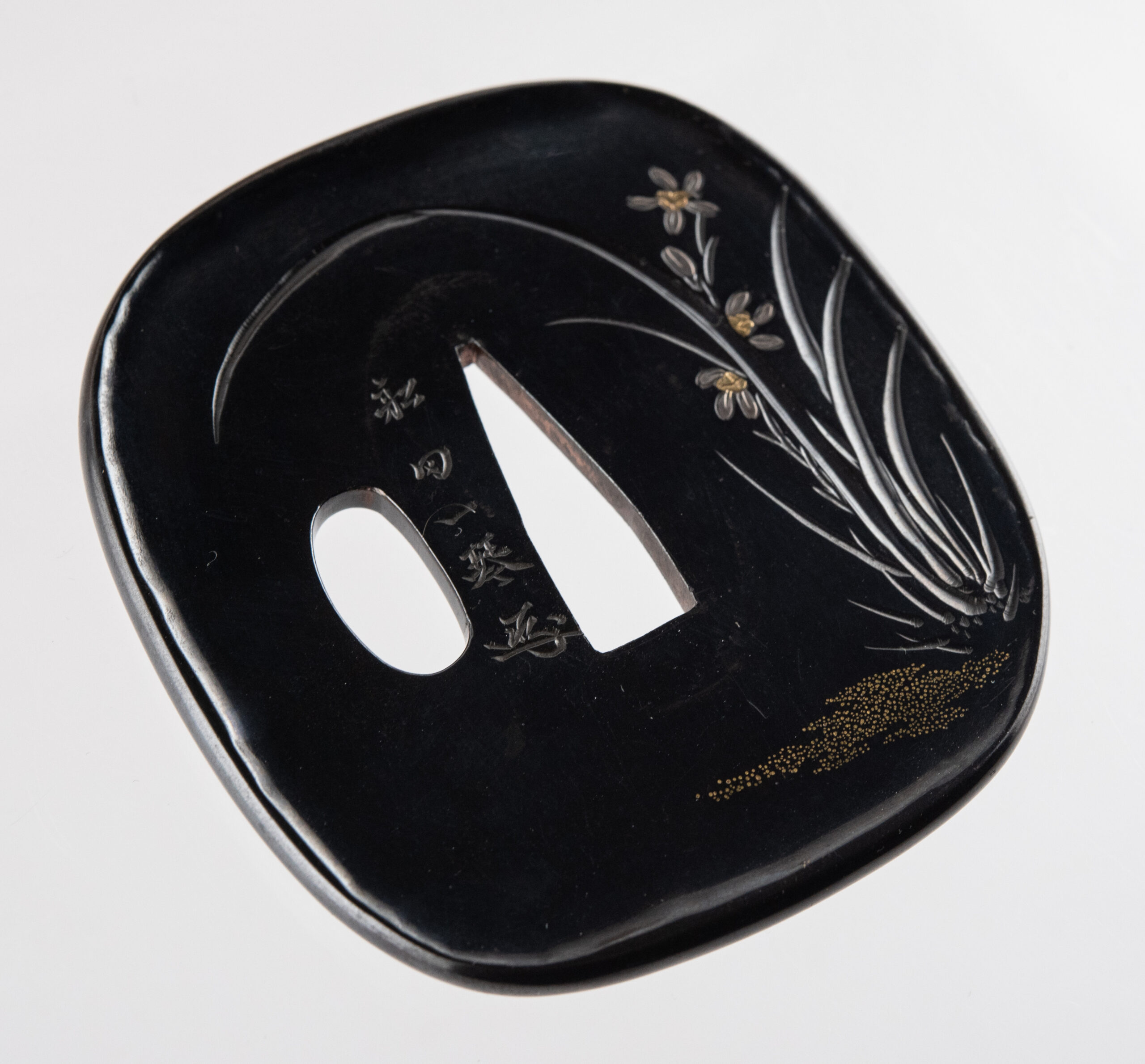
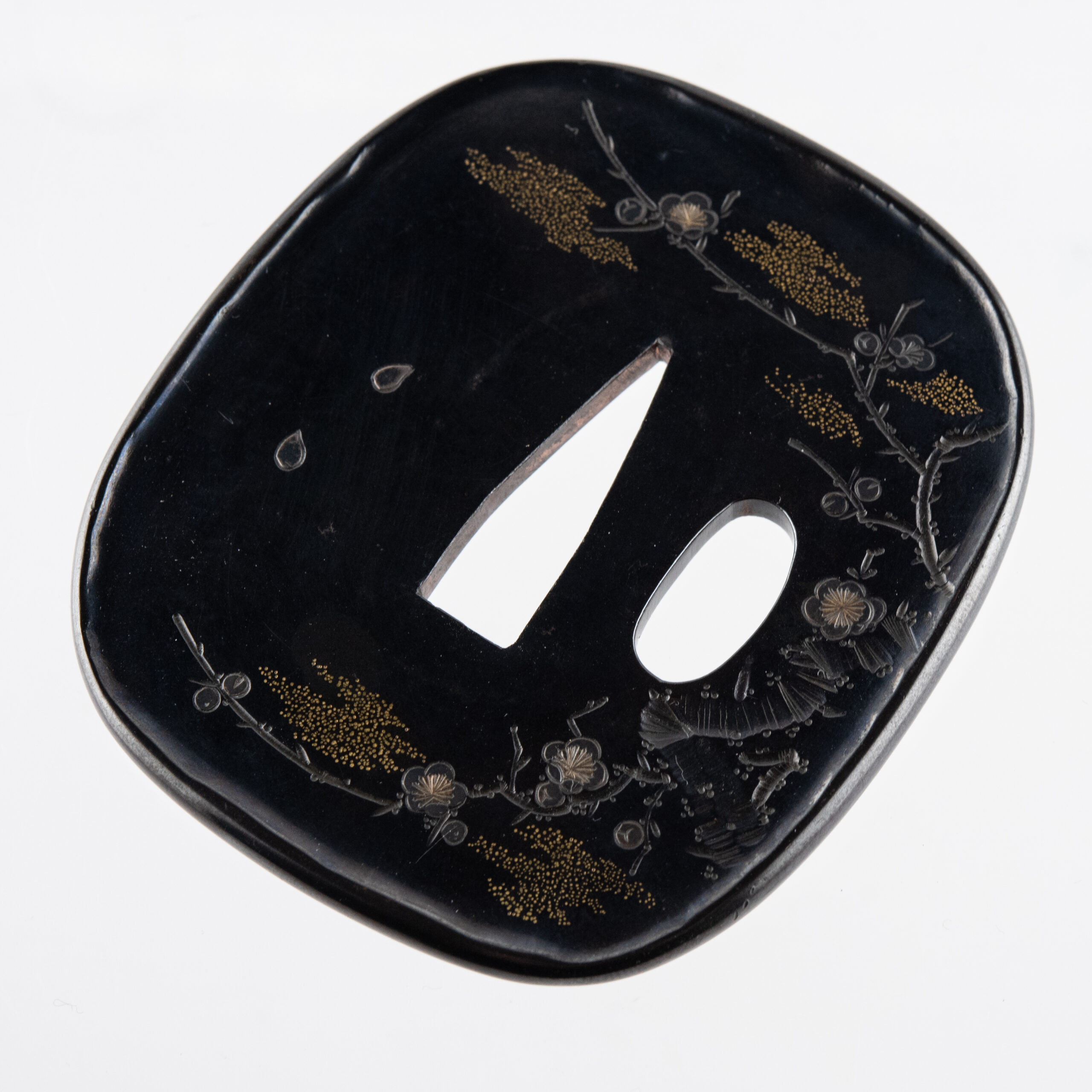
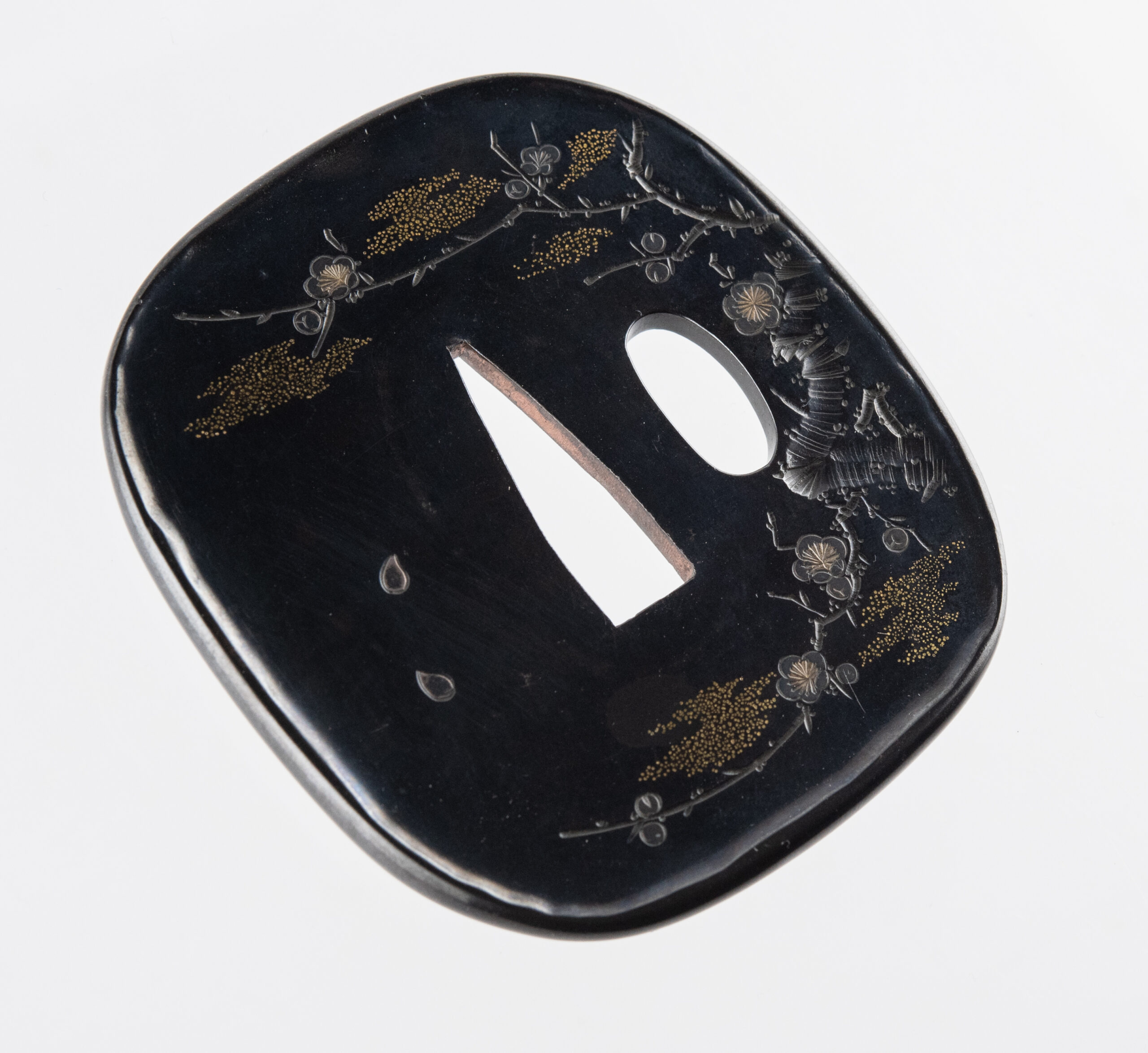
This refined Tsuba is a work by the second-generation Funada Ikkin (ca. 1840–1885), an accomplished metalworker of the Ichijo school. The front bears the signature Funada Ikkin with kao, and the NBTHK awarded the piece Tokubetsu Hozon certification.
Workmanship and Design
The artist made the Tsuba entirely from shakudo and finished the plate in migaki-ji, creating a smooth, polished surface that emphasizes the deep color of the alloy. The plate has one kozuka-hitsuana and is otherwise solid. Toward the edge, the artist gently hammered the plate upward, producing a subtly raised rim and a restrained three-dimensional profile (uchikaeshi-mimi).
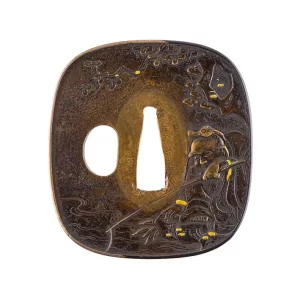
On the right side of the front, a delicately rendered lily, probably a water lily, rises against the polished shakudo ground. Silver forms the petals, while gold highlights the flower centers. Fine point-like gold decoration in keshi-komi zogan appears beneath and around the motif, adding a restrained shimmer to the otherwise dark surface.
The contrast between the polished black shakudo and the sparse silver and gold details gives the composition an elegant and highly controlled appearance.
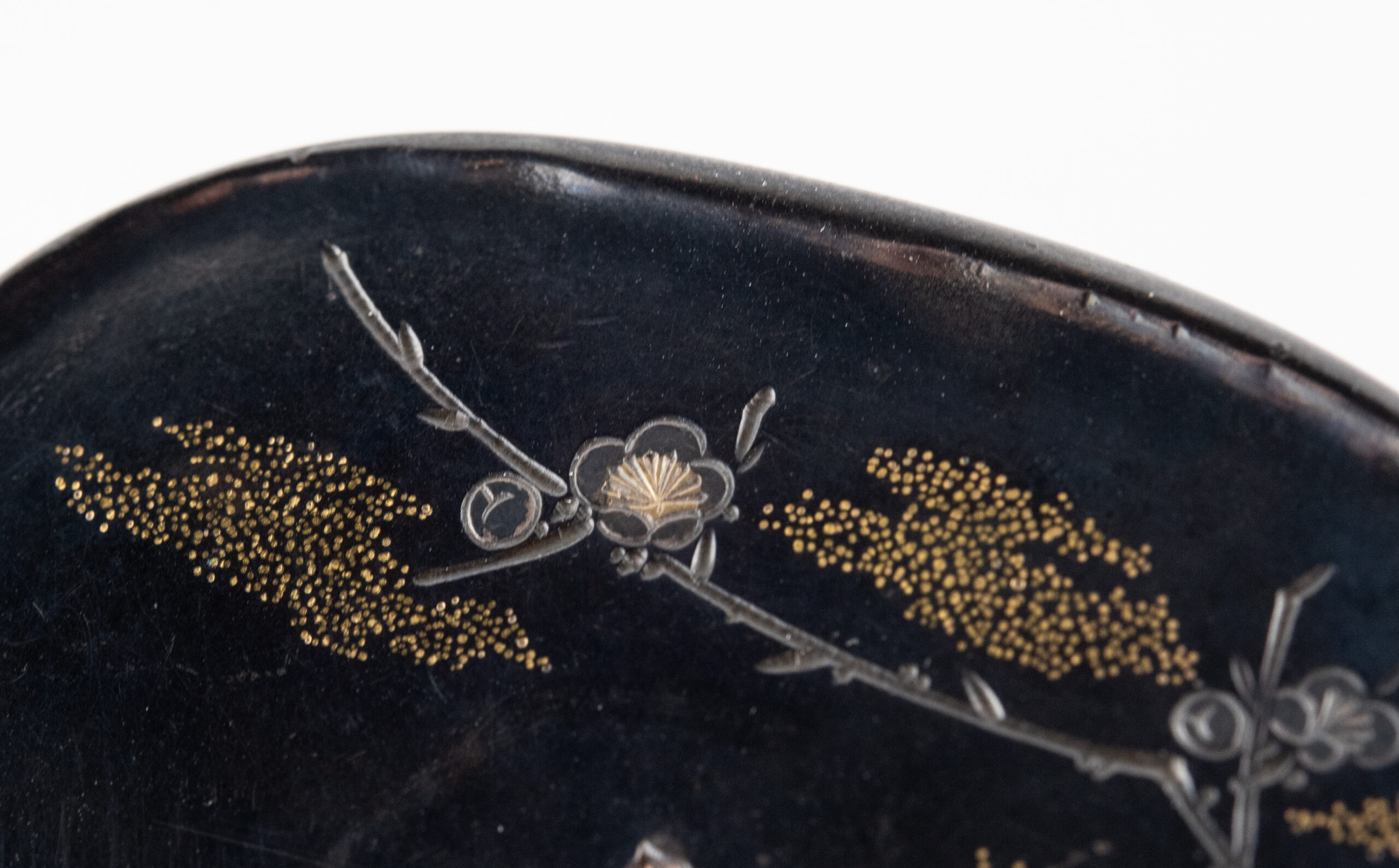
The reverse depicts a flowering plum branch, a motif closely associated with the work of Ikkin. The artist modeled the branches and twigs with rounded chisel work rather than katakiri-bori, giving them a softly sculptural character. Silver forms the petals of the plum blossoms, while gold accents their centers. Fine point-like gold decoration surrounds the motif and echoes the treatment on the front.
About Funada Ikkin II
The second-generation Funada Ikkin (ca. 1840–1885) was the son and successor of the first Funada Ikkin. He continued the highly refined metalworking tradition associated with Goto Ichijo and the Ichijo school. His work is known for carefully controlled carving, polished shakudo grounds and sophisticated combinations of precious-metal decoration.
Details
Artist: Funada Ikkin II (ca. 1840–1885)
Period: Late Edo to early Meiji period
Signature: Funada Ikkin with kao
Certificate: NBTHK Tokubetsu Hozon
Material: Shakudo
Surface: Migaki-ji
Decoration: Silver and gold
Length: 73.6 mm / 2.90 in
Width: 66.2 mm / 2.61 in
Thickness at seppa-dai: 3.6 mm / 0.14 in
Comes with a custom Kiri box
二代 船田一琴 鍔
一乗派の優れた金工として知られる二代船田一琴(約1840–1885)による上質な鍔です。表には「船田一琴」花押の銘があり、本作にはNBTHK特別保存刀装具鑑定書が付属します。
赤銅磨地
地金は赤銅で、表面は滑らかな磨地に仕上げられています。赤銅特有の深い色調と艶やかな表面が、金銀の装飾を美しく引き立てています。小柄櫃孔を一つ備え、その他は地透かしのない構成です。耳に向かって地板をわずかに打ち上げることで、縁部に穏やかな高さと立体感を持たせています。
睡蓮の意匠
表の右側には、睡蓮と思われる百合の花が繊細に表されています。花弁は銀、花の中心部は金で装飾されています。その下から周囲には微細な点状の金装飾が施され、黒く艶やかな赤銅地の上に控えめな輝きを添えています。
磨き上げられた赤銅の深い黒色と、限られた金銀の色彩との対比が、非常に洗練された構成を生み出しています。
裏面の梅花
裏面には、一琴の作品に特徴的な梅の意匠が表されています。枝や小枝は片切彫ではなく、丸みを持たせた鏨仕事によって立体的に表現されています。梅花の花弁には銀、花芯には金を用い、その周囲には表面と呼応する微細な点状の金装飾が施されています。
二代船田一琴について
二代船田一琴(約1840–1885)は初代船田一琴の子で、その跡を継いだ金工です。後藤一乗に連なる高度な金工技術と美意識を受け継ぎ、精緻な彫技、磨き上げた赤銅地、そして金銀を用いた洗練された色絵表現を特徴とする作品を残しました。
作品詳細
作者:二代 船田一琴(約1840–1885)
時代:江戸時代末期~明治時代初期
銘:船田一琴 花押
鑑定書:NBTHK 特別保存刀装具
材質:赤銅
地:磨地
装飾:銀・金
縦:73.6 mm / 2.90 in
横:66.2 mm / 2.61 in
切羽台厚:3.6 mm / 0.14 in