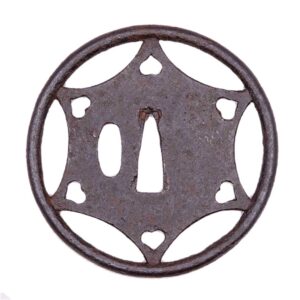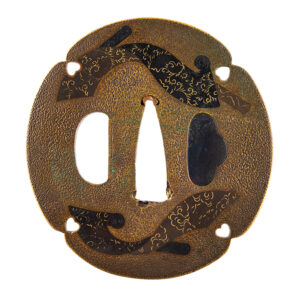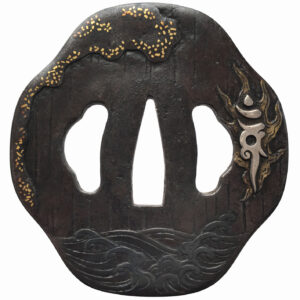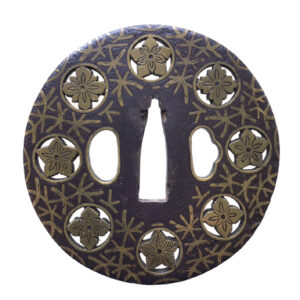
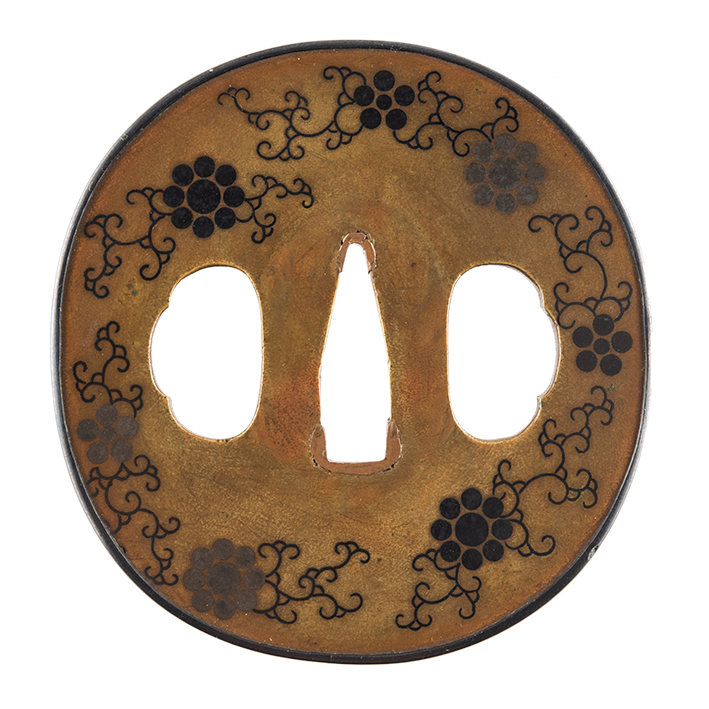
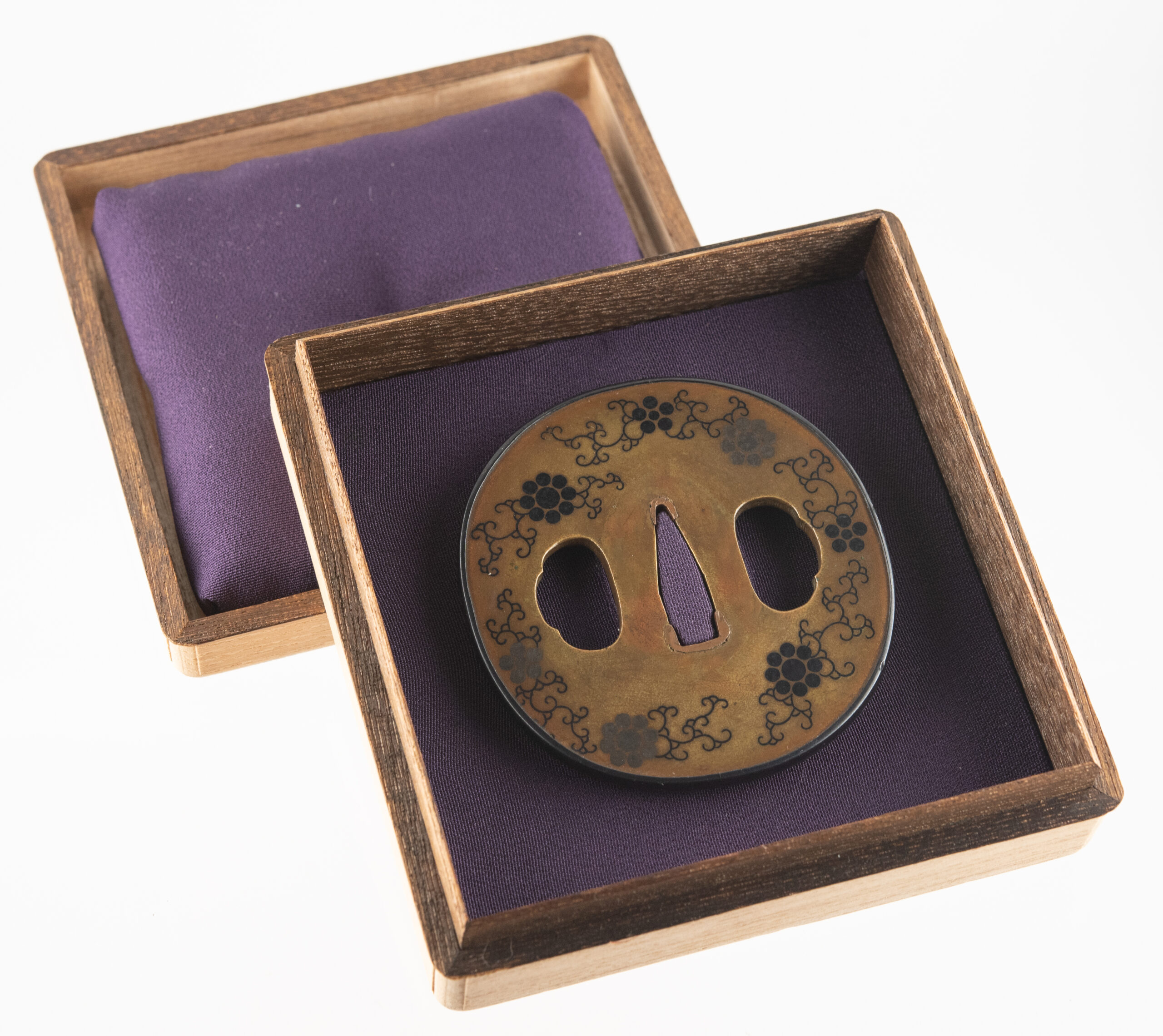
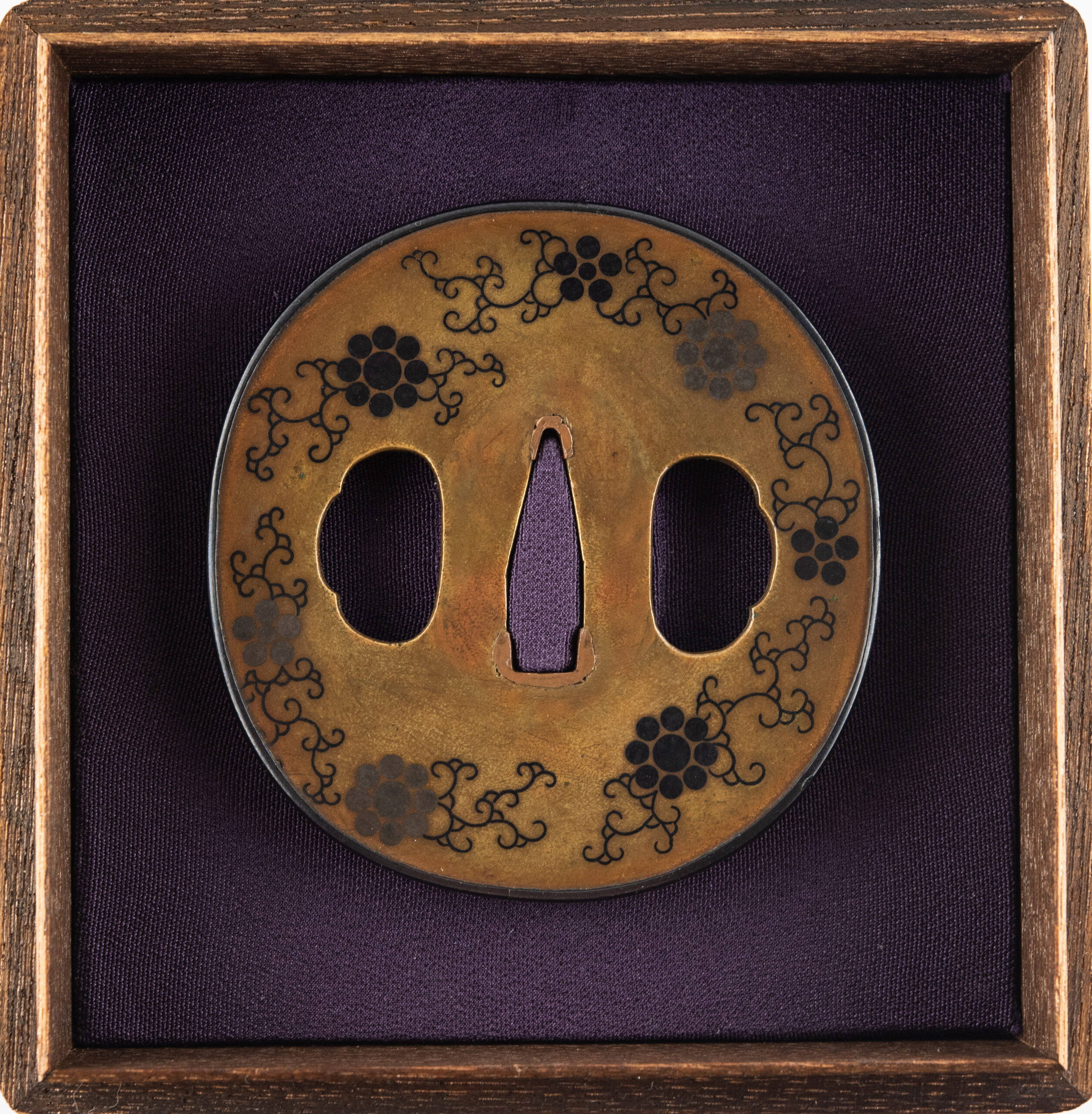
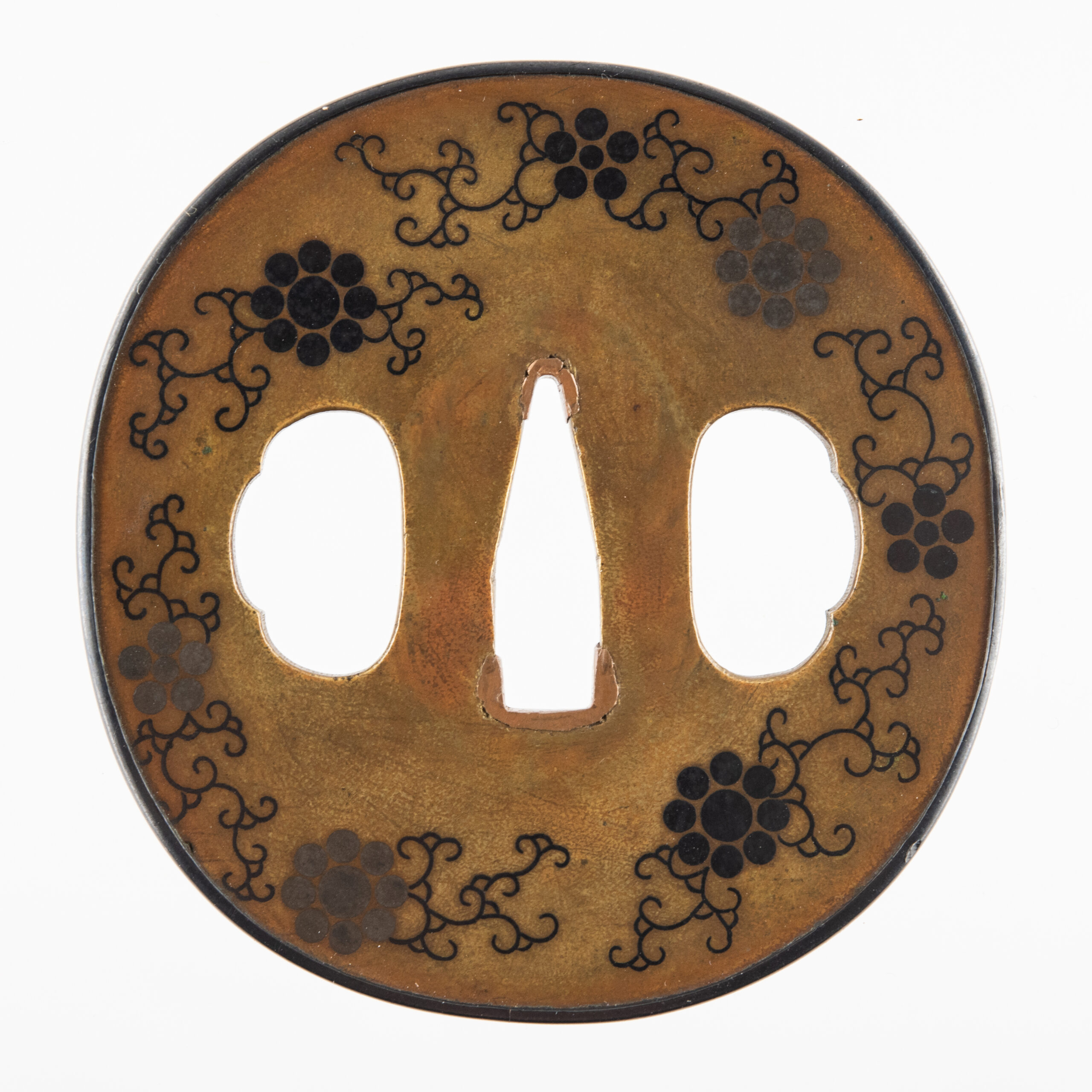
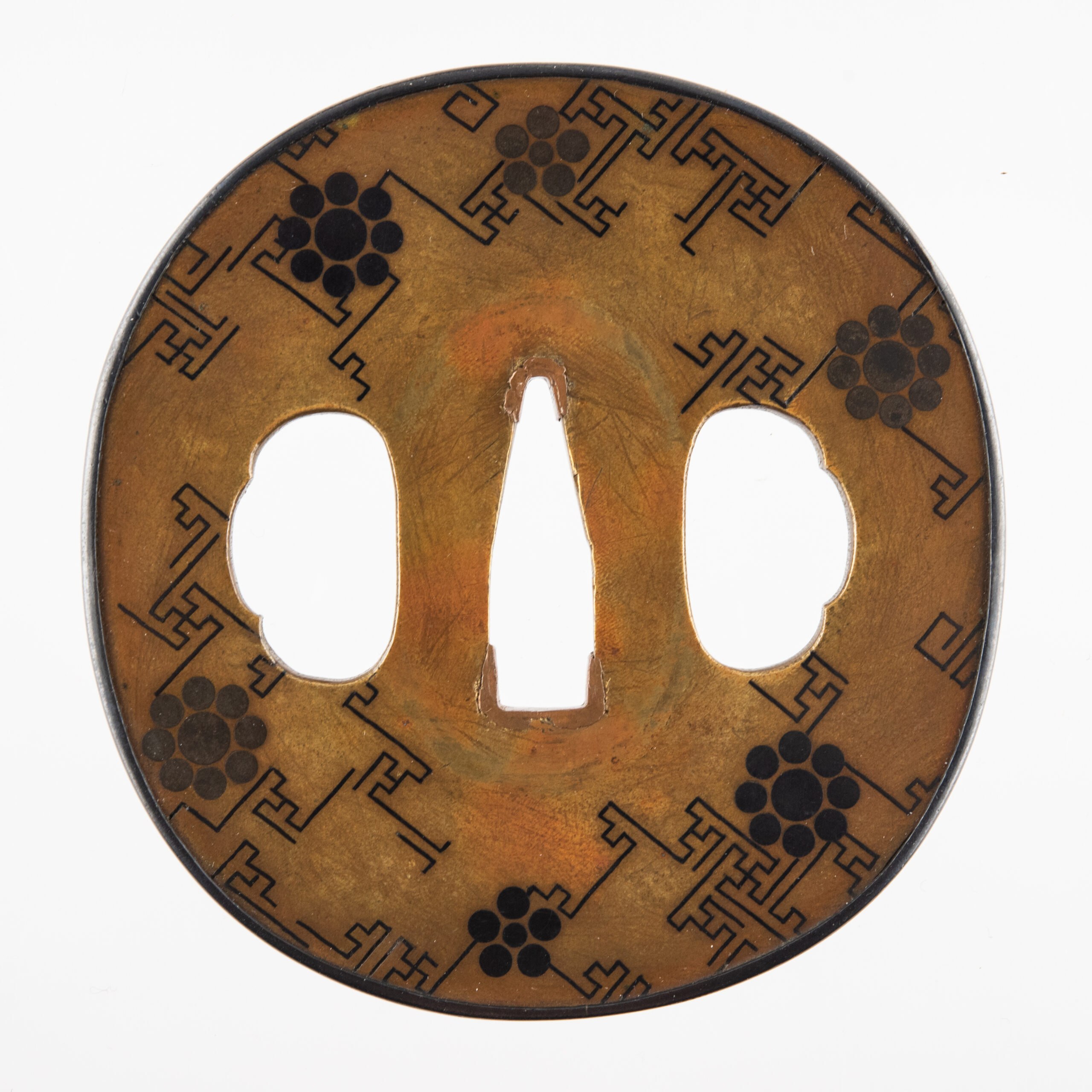
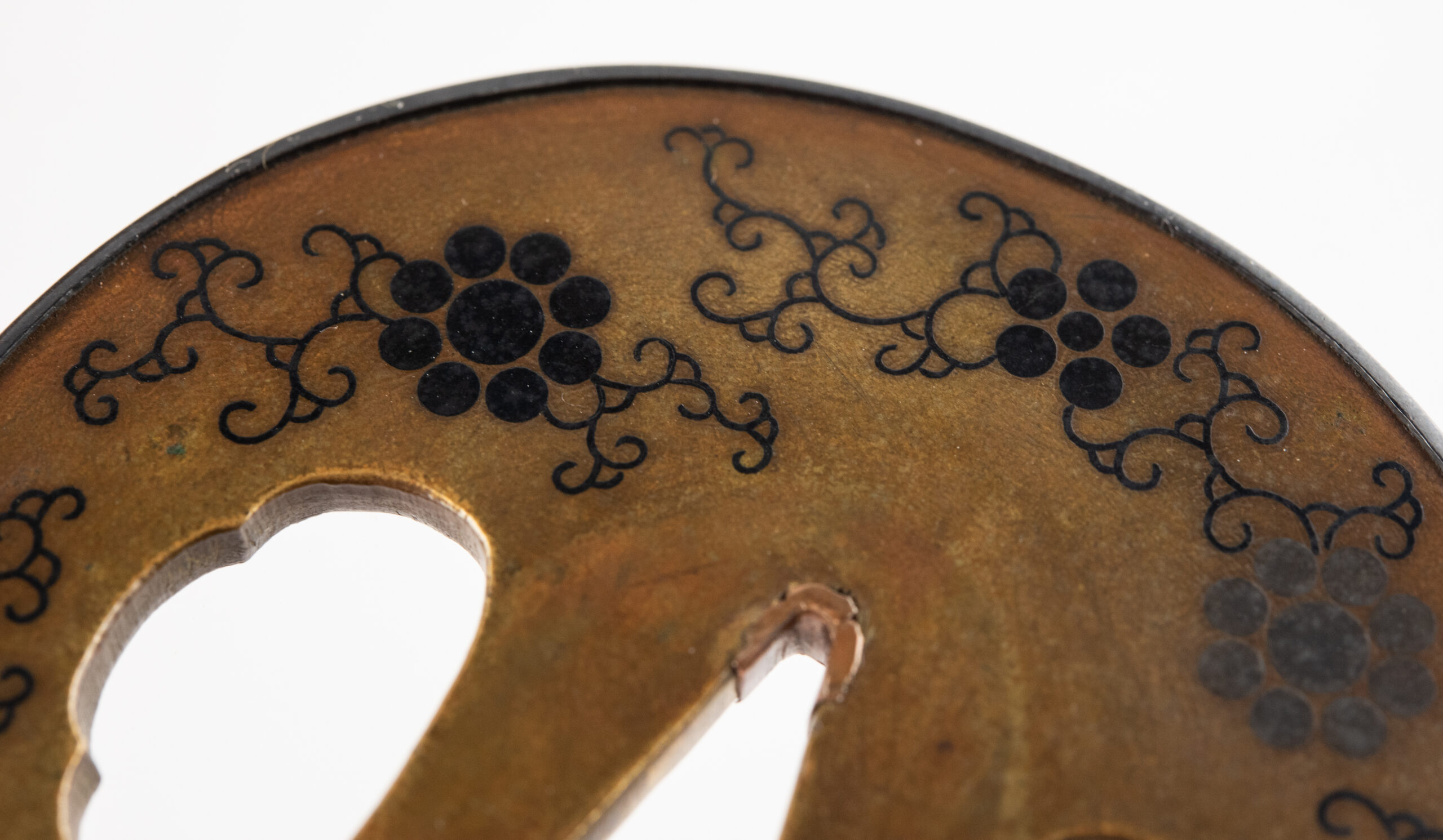
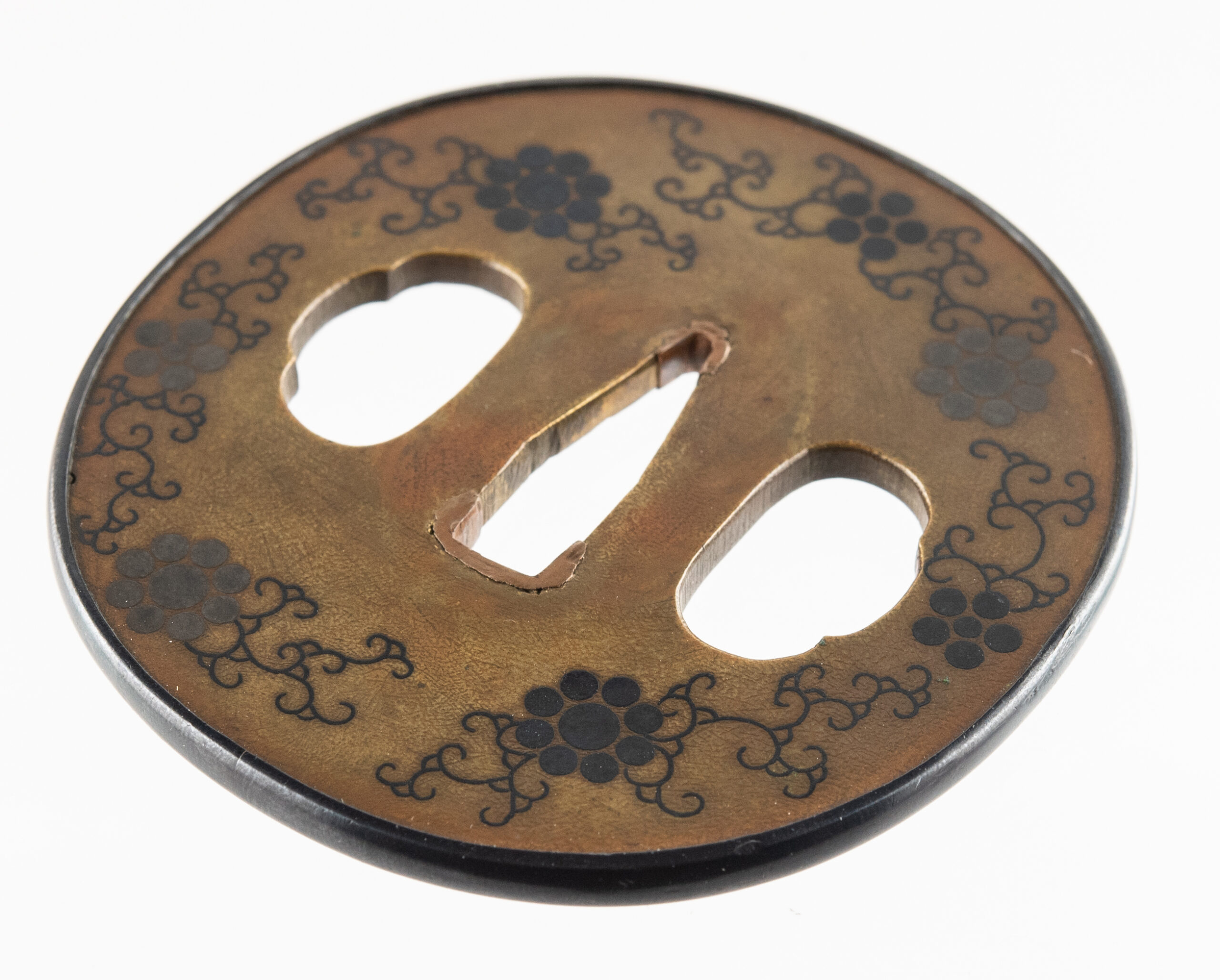
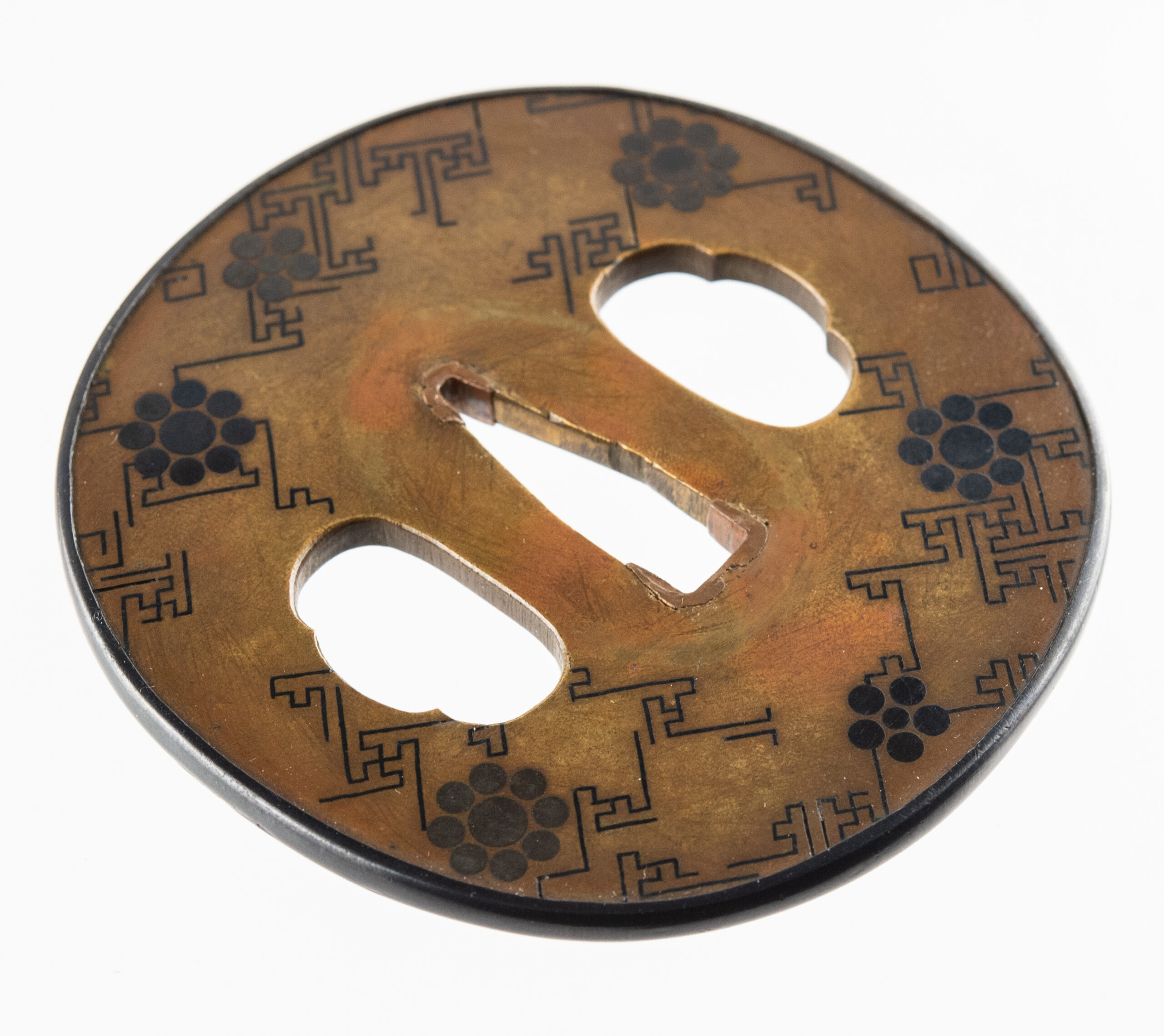
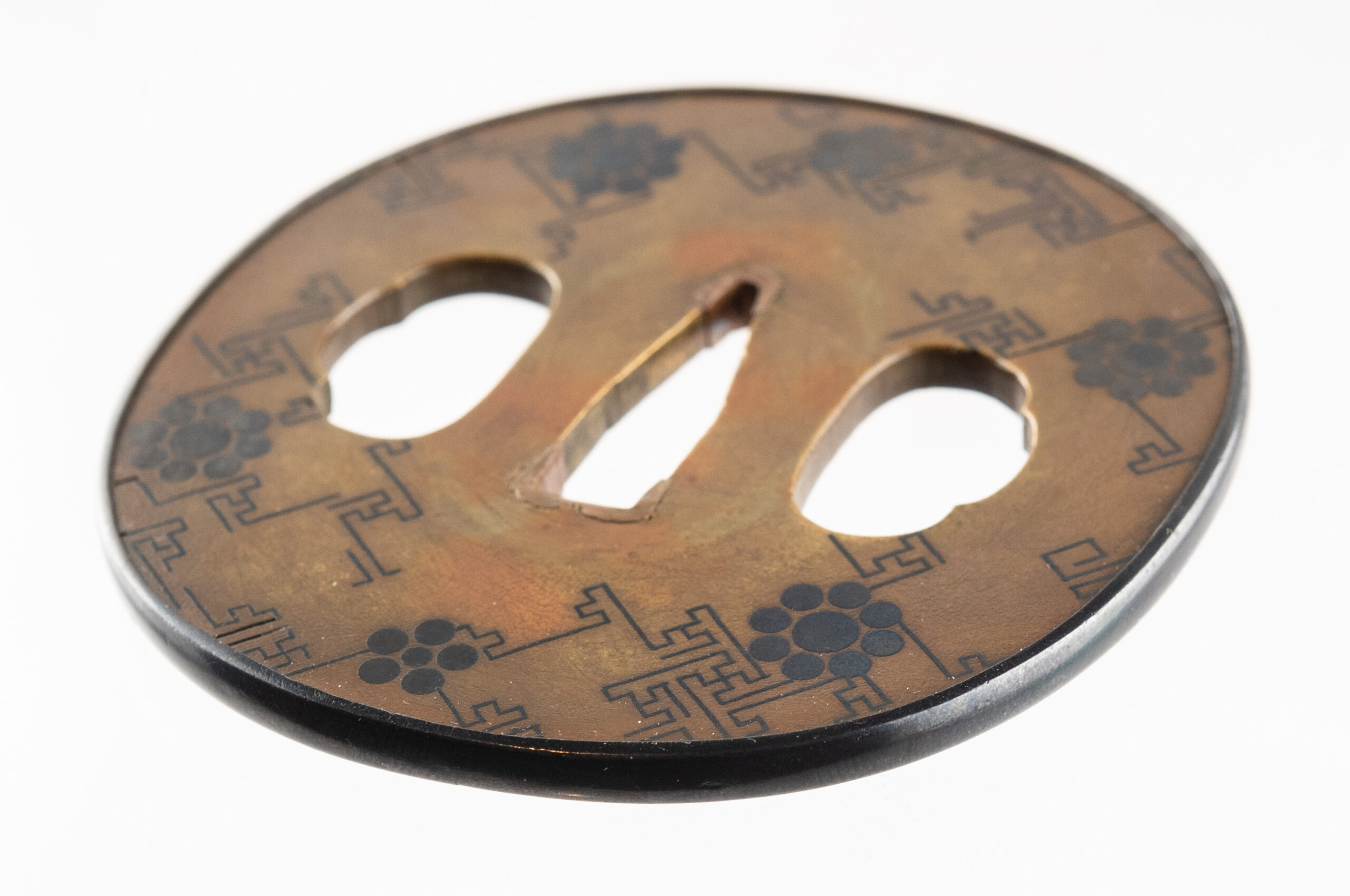
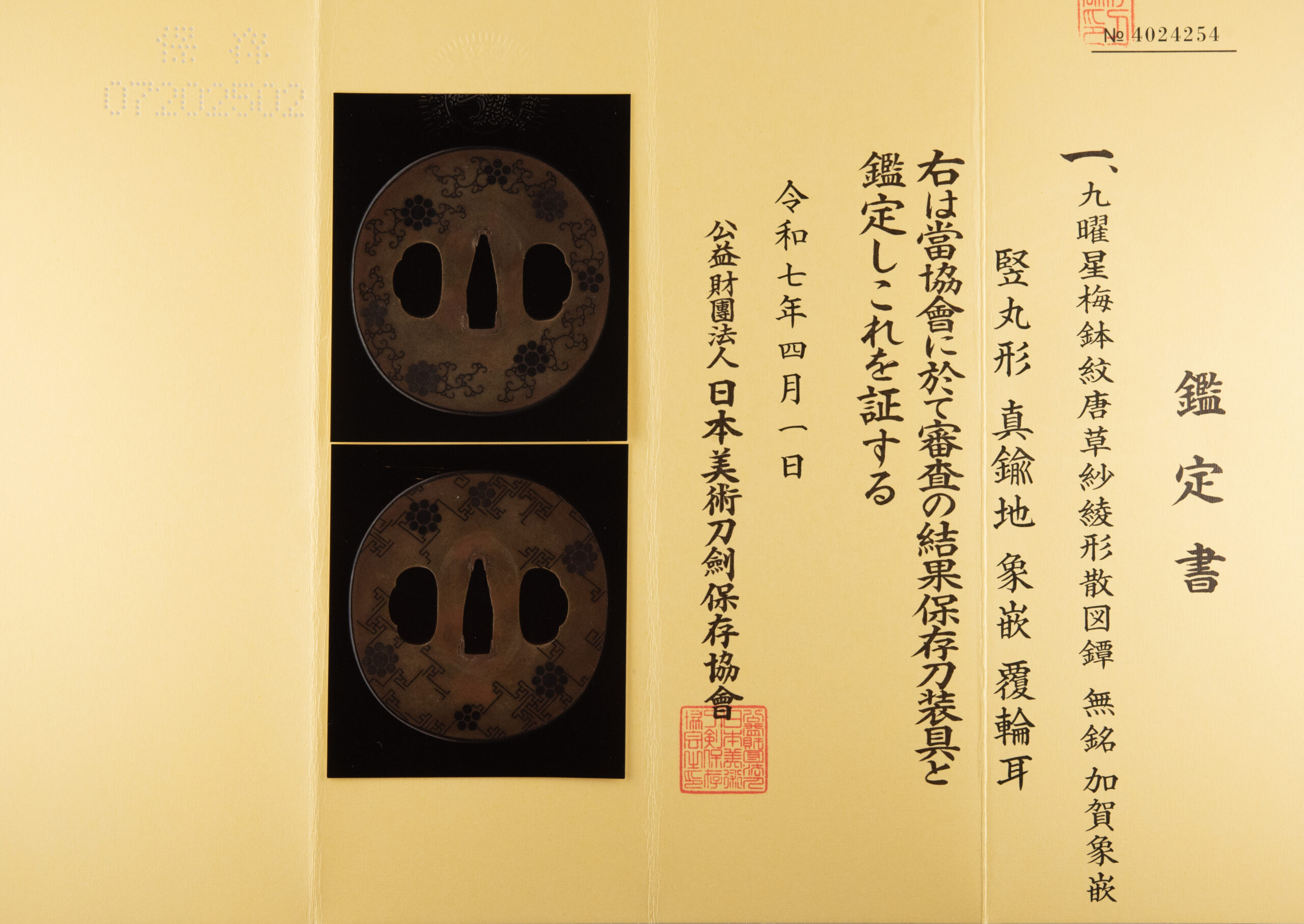
This refined Kaga Zogan Tsuba dates from the early to middle Edo period. The NBTHK issued a Hozon certificate for the piece with an attribution to Kaga Zogan.
Design and Materials
The maker used sentoku, an old copper alloy related to brass, for the plate. Its surface has developed a particularly attractive deep patina with dark greenish and reddish-brown tones. A shakudo rim surrounds the plate, which has a solid construction apart from the two hitsu-ana.
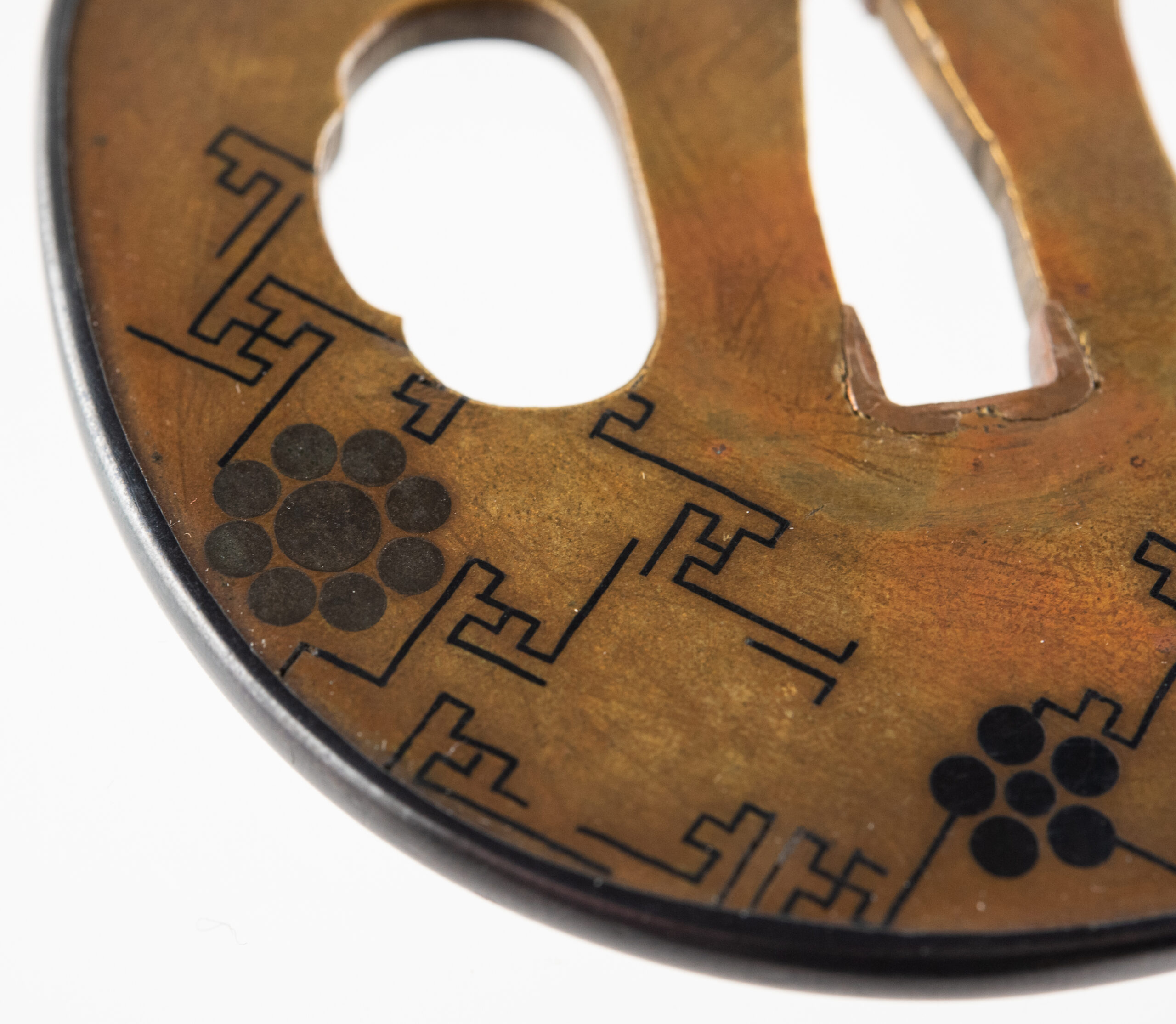
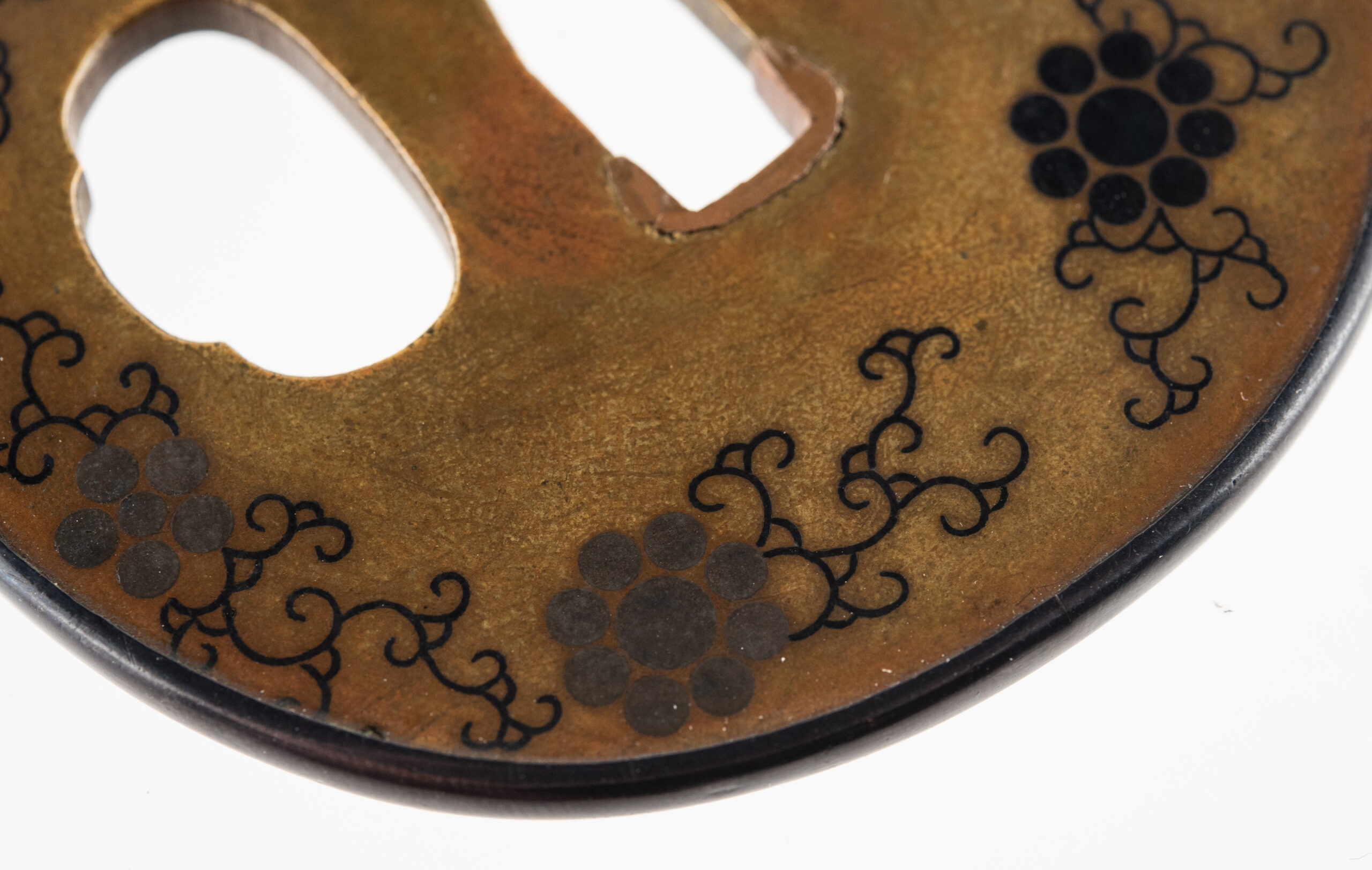
Exceptionally fine inlay decorates the front. Delicate shakudo warabite motifs accompany the Hosokawa kuyomon and the Toda family’s hanare mutsuboshi (“detached six stars”) mon. The artist rendered three of the mon in shibuichi and four in shakudo.
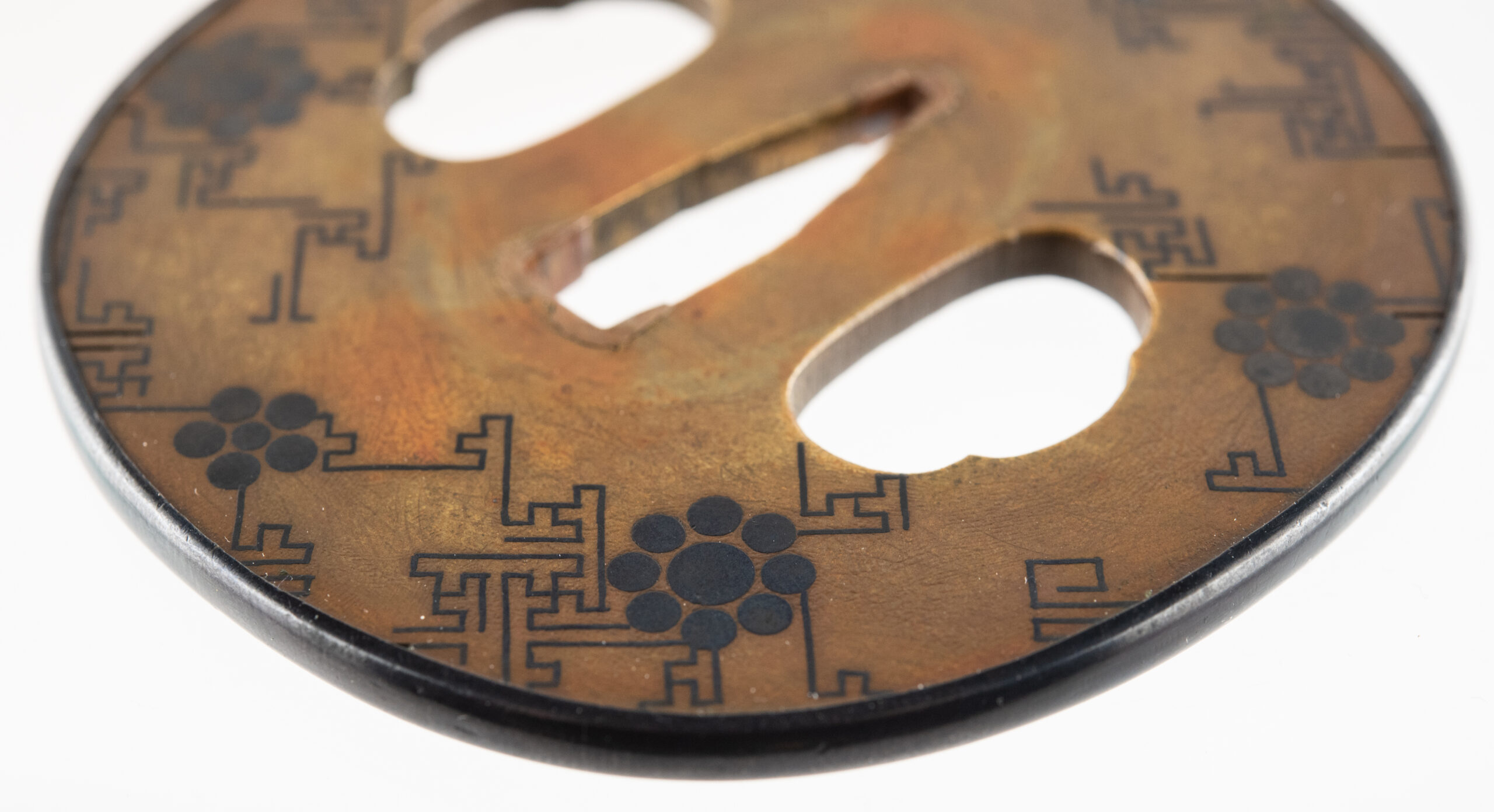
The reverse follows a closely related composition. It displays four Hosokawa mon and two Toda mutsuboshi mon. Three appear in shibuichi and three in shakudo. Instead of the warabite decoration, extremely fine shakudo lines form a traditional Japanese geometric pattern reminiscent of sayagata.
The Toda family, a fudai daimyo house, used the hanare mutsuboshi mon. The Toda ruled Matsumoto from 1617 to 1633 and returned to Matsumoto in 1726, where they remained until the end of the Edo period. Branches of the wider Toda family also ruled other important domains, including Utsunomiya. Through its close relationship with Tokugawa Ieyasu, the Toda line associated with Matsumoto received permission to use the Matsudaira name.
The combination of the Toda mutsuboshi and Hosokawa kuyomon on the same Tsuba makes this piece particularly intriguing. It may reflect a personal, marital, or political connection between members of the Toda and Hosokawa houses. The high quality of the workmanship also suggests a special commission for a person of considerable rank. However, no surviving documentation identifies the original owner, so the exact nature of this connection remains uncertain.
Attribution and Style
The NBTHK attributes the Tsuba to Kaga Zogan, yet the design displays a pronounced Higo aesthetic. The character and treatment of the sentoku surface also recall early Umetada work. A related surface-treatment technique, possibly using an arsenic-bearing agent, may have produced this rich patina.
Details
Period: Early to middle Edo period
Attribution: Kaga Zogan
Certificate: NBTHK Hozon
Material: Sentoku with shakudo rim; shakudo and shibuichi inlay
Length: 76 mm / 2.99 in
Width: 73 mm / 2.87 in
Thickness: 4 mm / 0.16 in
With custom made box
加賀象嵌鍔
江戸時代前期から中期頃の作と考えられる、非常に上質な加賀象嵌鍔です。NBTHK保存刀装具鑑定書が付属し、「加賀象嵌」と鑑定されています。
意匠と材質
地金は宣徳で、古い真鍮系銅合金特有の、暗い緑色から赤褐色を帯びた非常に美しい古色を呈しています。周囲には赤銅の覆輪が施され、二つの櫃孔以外は地透かしのない堅実な板鍔です。
表面には極めて繊細な象嵌が施されています。赤銅による細かな蕨手文様とともに、細川家の九曜紋および戸田家の離れ六つ星紋が配されています。紋のうち三つは四分一、四つは赤銅で象嵌されています。
裏面もこれに近い構成で、細川九曜紋四つと戸田家の離れ六つ星紋二つを配し、そのうち三つを四分一、三つを赤銅で表しています。蕨手文様の代わりに、非常に細い赤銅象嵌線による伝統的な幾何学文様(紗綾形を思わせる文様)が施されています。
戸田家と細川家の家紋
離れ六つ星紋は戸田家が用いた家紋で、戸田家は譜代大名として知られています。戸田氏は1617年から1633年まで松本を治めた後、1726年に再び松本へ入封し、江戸時代末期まで松本藩主を務めました。また、広い戸田一族には宇都宮などの重要な藩を治めた系統もありました。松本の戸田家は徳川家康との深い関係から松平姓の使用も許されています。
同一の鍔に戸田家の離れ六つ星紋と細川家の九曜紋が組み合わされている点は特に興味深く、戸田家と細川家の人物間に婚姻・親族関係、あるいは政治的な縁が存在した可能性を示唆します。また、その高い製作技術からも、相当な身分の人物のための特別注文品であった可能性が考えられます。ただし、旧蔵者を示す史料がないため、両家の具体的な関係については推測の域を出ません。
鑑定と作風
鑑定は加賀象嵌ですが、作品全体には強い肥後金工的な美意識が感じられます。また、宣徳地の表面処理と古色には初期埋忠の作品を想起させる特徴も見られます。この豊かな古色には、初期埋忠の合金鍔に関連する表面処理技法、あるいは砒素を含む薬剤を用いた技法との関連も考えられますが、直接的な技法上の関係を現時点で断定することはできません。
作品詳細
時代:江戸時代前期~中期
鑑定:加賀象嵌
鑑定書:NBTHK 保存刀装具
材質:宣徳地、赤銅覆輪、赤銅・四分一象嵌
縦:76 mm / 2.99 in
横:73 mm / 2.87 in
厚さ:4 mm / 0.16 in